Adoptionplaybook
Better AI prompts for business teams: a plain guide with templates
A simple five-part structure for writing prompts that give usable results, with copy-and-paste templates for marketing, sales, HR and operations.

In this article
Your team is probably already using AI: ChatGPT, Claude, Copilot, Gemini or a feature built into software you pay for. And if people are honest, about half the time it doesn’t quite work. The result is generic, it misses the point, or it needs so much editing that writing it yourself would have been quicker.
That is rarely a problem with the tool. It’s a problem with the instructions.
Prompt engineering sounds technical, but for business use it is simply the skill of telling an AI what you need clearly enough to get something usable. It is closer to writing a good brief than to writing code, and a team can learn the basics in an afternoon.
Why prompts fall short
Three patterns show up in nearly every prompt that disappoints.
- Too vague. “Write a blog post about our product” says nothing about who will read it, what it should achieve, what tone to use or how long it should be.
- No context. The AI doesn’t know your company, customers or brand voice, or what you’ve already tried. Without that, it guesses, and it guesses generically.
- No format. If you don’t say what you want back, it chooses. You get five paragraphs when you needed three bullets for a message.
McKinsey’s research shows how far most companies still have to go: only 1% of leaders described their companies as mature in their use of AI, meaning it is built into workflows and driving real results. Better instructions are one of the cheapest places to close that gap.
A five-part structure for any prompt
Include as many of these as the task needs. More context nearly always means a better first draft.
| Part | The question it answers |
|---|---|
| Role | Who should the AI act as? |
| Context | What is the situation, audience or goal? |
| Task | What exactly should it do? |
| Constraints | What are the limits: length, tone, format, things to avoid? |
| Output | What should the result look like? |
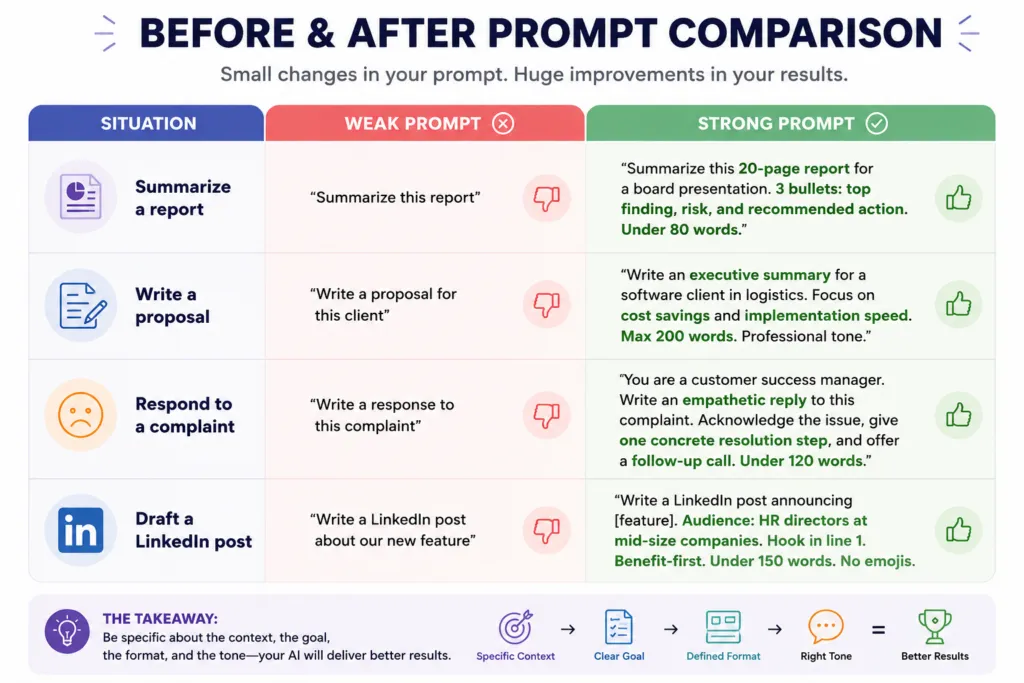
A weak prompt:
Write an email to follow up with a client.
The same request with the structure:
You are a senior account manager. A client attended our product demo three days ago and hasn’t replied to our follow-up. Write a follow-up email that re-engages them without being pushy. Under 100 words, friendly but professional, don’t mention competitors. Give me the subject line and the body only.
The second version takes thirty seconds longer to write and usually saves ten minutes of editing.
Templates by team
Copy these and replace the brackets with your own details.
Marketing
Blog introduction
You are a content writer for [company], which [what you do] for [audience]. Write a 600-word introduction on [topic]. Tone: [conversational / authoritative / educational]. Start with a strong first sentence, include one relevant statistic with its source, and end with a line that leads into the main text. Avoid stock phrases such as “in today’s world”.
Social captions
Write three LinkedIn caption options about [topic] for [audience] in [industry]. Each under 150 words, opening with a statement rather than a question. Finish without a generic call to action.
Sales
Preparing for a call
I’m preparing for a sales call with [company]. Based on what you know about [their industry], summarise: their three likely operational challenges, how a company like ours ([short description]) usually helps, and two good opening questions. Keep it to one page.
Shortening a proposal
Rewrite this proposal summary for a [industry] executive who has three minutes to read it. Prioritise results, timeline and risk. Maximum 200 words, no jargon. [Paste text]
HR and people
Job description
Write a job description for a [title] at [company description]. The role reports to [manager]. Main responsibilities: [3–5 points]. Tone: direct and welcoming, no gendered language. Format: short introduction, five responsibilities, four must-haves, two nice-to-haves, one closing sentence.
Performance review draft
You are an experienced HR manager. Draft a review for a team member who [brief description of role and performance]. Be honest, specific and constructive: three paragraphs on strengths, two on areas to develop. Avoid vague praise.
Operations and analysis
Meeting summary
Summarise these notes as: a three-sentence overview, key decisions as bullets, action items with owners and deadlines, and any open questions. [Paste notes]
Reading the numbers
You are a business analyst. Here is our [weekly/monthly] data: [paste]. Identify the three main trends, flag anything unusual and suggest two actions to consider. Give a table first, then a short narrative under 150 words.
Never paste confidential customer or company data into a tool your company hasn’t approved. If you don’t yet have a policy on what can go where, write one before the templates spread.
Build a shared prompt library
Individual skill is a good start. The teams that get lasting value keep what works in one shared place, such as a spreadsheet, a Notion page or your CRM, organised by team and use case.
That means good prompts don’t stay in one person’s browser history, new joiners get up to speed faster, nobody rebuilds the same prompt every month, and you can test and improve what you have. A useful entry records:
- the use case it solves
- the team that uses it
- the full prompt, ready to paste
- which tool it was tested in
- a quality rating and the date it was last checked
- notes on what works and what to watch for
Start with ten prompts. Review them monthly, add the ones that earn their place and delete the rest.
Mistakes worth avoiding
- Asking for too much at once. A blog post, three captions and an email subject line is four tasks. Split them and each result improves.
- Treating the first answer as final. Treat it as a draft and keep going: “shorter”, “less formal”, “add a concrete example to the second paragraph”.
- Not saying what to avoid. If you don’t want bullet points, jargon or competitor names, say so. The AI won’t assume.
- Skipping the role. “You are a senior financial analyst” produces a different answer from “You are a helpful assistant”, because it draws on a different style and body of knowledge.
- Assuming one prompt fits every tool. OpenAI’s prompt engineering guide covers model-specific differences worth knowing.
Checking that it’s working
You don’t need a data team. Three informal measures are enough:
- Time to usable draft. How long from prompt to something you would actually send? Track it for a week before and after introducing the structure.
- Edit ratio. Roughly how much of the output do you change? If it’s more than half, the prompt needs more context.
- Reuse. How often are prompts from the library used? Frequent reuse means a prompt solves a real, recurring problem.
Where we come in
Better prompting makes the tools you already pay for more useful, and it is one part of getting AI to show up in the numbers. If you’d like your team trained on tasks from your own business, or a prompt library built around your workflows, that is part of our AI implementation and automation work, and you can talk to us about where to begin.
Questions
What is prompt engineering in simple terms?
Writing clear, structured instructions for an AI tool so it gives specific, useful results instead of generic ones. It is closer to briefing a contractor than to programming.
Do we need to code to write good prompts?
No. Prompts are written in plain language. If you can write a clear email brief or project scope, you already have the core skill. What takes practice is knowing what to include and how specific to be.
How long does it take a team to get good at it?
Most people see better results the same day after a short workshop on their own tasks. Building shared habits and a prompt library takes a few weeks of light practice.
Does the same prompt work in every AI tool?
The principles carry across ChatGPT, Claude, Gemini and Copilot, but each responds a little differently. Test your best prompts in the tools your team actually uses and adjust the wording where needed.
What is the biggest mistake teams make?
Typing a prompt the way they would type into a search engine. AI responds to instructions, so a short, vague request gets a short, vague answer.