AIguide
Agentic AI in 2026: what business leaders need to know
What AI agents actually do, where they already work, why so many projects stall, and how to start with one workflow instead of a company-wide bet.

In this article
There is a line most companies haven’t crossed yet, and it has little to do with whether they use AI. It’s about what the AI is allowed to do.
For the past few years, “adopting AI” meant giving people a chatbot, a writing assistant or a dashboard with forecasts. The AI answered questions. People still made the decisions and did the follow-through.
AI agents change that. This article explains what they are, where they already work, why so many projects stall, and how to begin without betting the company on it.
What an AI agent is
Give a standard AI tool a task and it hands back an output. Give an AI agent a goal and it works out the steps, uses the tools it has been given (databases, business software, a browser), carries the steps out, checks its own work and changes course when something fails.
The difference is the one between a colleague who answers your question and one who runs the whole job. Inside business software, that looks like a support ticket handled from first message to resolution, code written and tested before a person reviews it, or a procurement request checked against policy and routed for approval.
Where things stand
The numbers show a market that is moving, but unevenly.
- Gartner expects 40% of enterprise applications to include task-specific AI agents by the end of 2026, up from less than 5% in 2025.
- McKinsey’s State of AI survey (2025) found that 62% of organisations were at least experimenting with AI agents.
- Gartner also expects over 40% of agentic AI projects to be cancelled by the end of 2027, citing rising costs, unclear business value and inadequate risk controls.
Read together, those figures say that plenty of companies are trying agents and far fewer are getting them to pay. The gap between “experimenting” and “running in production with a measured result” is where most of the effort, and most of the failures, sit.
Why this year is different from the hype of 2023 and 2024
For most of 2023 and 2024, agents were a good demo. The models were capable, but the surrounding pieces were not: tools to coordinate several steps, controls on what an agent can touch, and common standards for connecting it to other software. Most pilots stalled.
Those pieces are now much better. Standards for connecting agents to business systems are settling, and the major software vendors build agent features into products companies already pay for. The question has moved from “can we build this?” to “can we run it well?”
Where agents already work
The uses that have moved from pilot to routine share a feature: a defined process, clear success measures and a person who can step in.
- Software development. Agents write code, run tests, spot bugs, propose fixes and open pull requests for a person to review. The saving shows up as shorter review cycles.
- Customer operations. The most mature area. Agents take in requests, find the information, and resolve or route them, including requests that used to need someone to search several systems.
- Financial monitoring. Agents watch transactions as they happen, flag anomalies, carry out pre-approved responses (such as holding a payment) and keep a full record for audit.
- Security. Agents correlate alerts and start the first response steps so analysts spend their time on the decisions that need judgement.
Why deployments stall
Three causes come up again and again.
They started with the technology, not the workflow. “What can our agent do?” is a weaker question than “Which process costs us the most in time, errors or headcount, and could an agent own part of it?” The companies running agents in production started with the second question.
They left the work unchanged. PwC’s analysis of agent projects argues that the technology supplies a minority of the value and that the rest comes from redesigning how work is done around it. Put an agent into a process nobody revisited and you get the same results, only faster.
They skipped governance. An agent that can act can also act wrongly, quickly and at scale.
What governance means in practice
This is the part leadership discussions tend to skip, because it sounds like paperwork. It isn’t. It’s what lets you give an agent more freedom over time with confidence, instead of pulling it back after a mistake.
- Permissions. Which systems can the agent reach? Which actions can it take alone, and which need approval?
- Audit trail. Every action logged, with enough context to see why it happened and who or what authorised it.
- Escalation. Clear rules for when the agent hands over to a person, and a handover that keeps the context.
- Monitoring. Some companies now run a second system whose only job is to watch the first for policy breaches and odd behaviour.
The decision you are actually making
Many leaders ask whether they should adopt AI agents. A more useful question is what happens to your position if competitors run them well in customer service, development or finance over the next year or two, and you don’t.
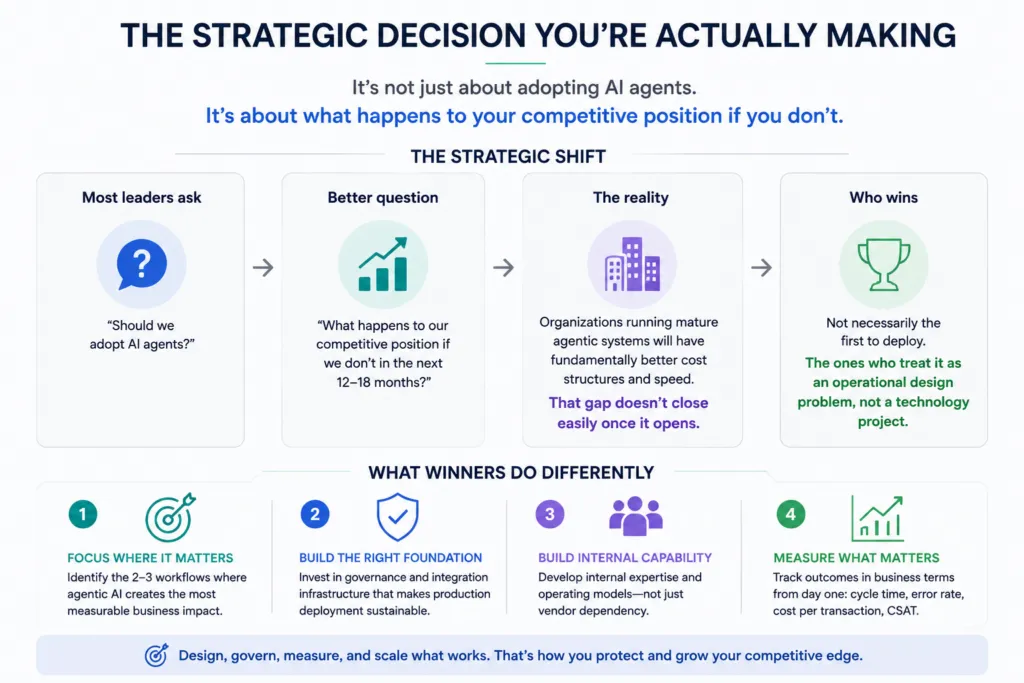
The companies that come out ahead won’t necessarily be the first to deploy. They’ll be the ones that treat it as a question of how work is designed, not as a technology project. In practice that means:
- choosing the two or three workflows where an agent would make the clearest difference
- investing in the governance and integration work that makes production use sustainable
- building skills in your own team so you aren’t wholly dependent on a vendor
- measuring results in business terms (cycle time, error rate, cost per transaction) from the first week
Starting small
If you are unsure where an agent would pay off, start with the stuck points in your own processes. A short list of the tasks that take the most hours, then a baseline measurement for each, is more useful than any vendor demo. Our AI Readiness Index gives you a view of your data, systems, people and governance in about six minutes, and our work on AI implementation and automation covers how we take one use case from pilot to production and measure it against that baseline.
Questions
What is the difference between agentic AI and the AI tools most people use?
A chatbot or writing assistant responds when you ask. An agent is given a goal and works towards it: it plans the steps, uses tools such as databases and business software, checks its own output and adjusts when something goes wrong. You move from using a tool to supervising a system.
Is agentic AI ready for business use?
For narrow, well-defined workflows, yes. Customer support triage, coding assistance, financial monitoring and security alerts all have working deployments. Broad, fully autonomous agents running high-stakes processes are not ready for most companies, so scope matters more than ambition.
What goes wrong most often?
Three things: no measurable business goal, no governance (limits, logs and escalation rules), and dropping agents into processes nobody redesigned. Gartner cites rising costs, unclear value and weak risk controls as reasons projects get cancelled.
How do we start without a large technical team?
Pick one workflow where the pain is clear, such as a task that eats hours or produces frequent errors. Many business platforms, including CRM, service desk and office suites, already offer agent features. Set the limits first, measure against today's numbers, and expand only what works.