Growthguide
Using generative AI in your SEO workflow without hurting your rankings
How to use AI for keyword research, drafting, on-page work and testing, with the human checks that keep content accurate, original and compliant.

In this article
Generative AI can write a page of search-friendly copy in a minute. That makes it tempting, and risky. Use it carelessly and you end up with pages that read like everyone else’s, contain mistakes and give search engines no reason to prefer them. Use it well and you can research faster, draft faster and test more, while the substance stays human.
This guide covers where AI helps in a search workflow, where it doesn’t, and the checks that protect your rankings and your reputation. If you are more interested in being quoted by AI assistants, see our companion piece on SEO for AI search.
What Google says about AI-written content
Google’s published position is that it rewards helpful, people-first content however it is produced, and that using AI to generate content mainly to manipulate rankings is spam. The distinction that matters is value, not method. A page that answers a real question, with real expertise and accurate information, is fine whether a person typed every word or edited an AI draft. A thousand thin pages produced in an afternoon are not.
How AI search changes the picture
AI search tools don’t just list links. They read several sources and write an answer, drawing on pre-trained knowledge and, increasingly, live web results. They tend to favour sources that are clear, complete and credible.
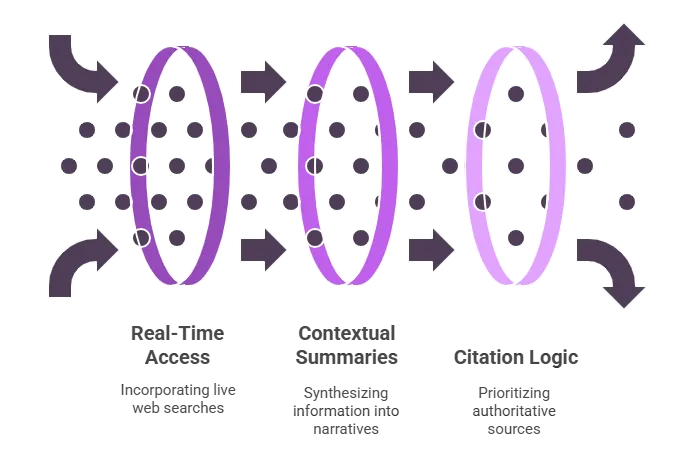
For you, that means pages need to be easy to read for machines as well as people: plain headings, direct answers, accurate facts and sources. These are the same qualities that have always made content useful.
Where AI helps in the workflow
Research and planning
AI can suggest topics, group keywords by intent, summarise what the top pages cover and point out gaps. Use it to widen your list of ideas, then check the numbers, such as search volume and competition, in a proper keyword tool. AI assistants can invent search volumes.
A useful way to organise keywords is by what the searcher wants:
- Informational: “what is predictive analytics”, “how does a sitemap work”
- Comparison or evaluation: “custom software vs off-the-shelf”, “best email platforms for retailers”
- Action: “hire a data analytics consultant”, “book an SEO audit”
Each intent calls for a different kind of page, so decide before you write.
Drafting
AI is good at producing an outline, a rough first draft and variations for different channels. It is poor at the parts that make content worth reading: original examples, a point of view, accurate details about your business and a distinctive voice. A reliable routine:
- A subject expert writes the brief: the question, the audience, the points to make and the sources to use.
- AI drafts an outline and a first version from those materials.
- A person rewrites for voice, adds examples and removes filler.
- A second person checks every fact, figure and link before it goes live.
On-page work
AI can draft title tags, meta descriptions and image descriptions quickly, and suggest ways to restructure a page. Keep titles under about 60 characters with the main idea first, write descriptions that say what the reader will get, and use one clear H1 with logical H2 and H3 headings below. Alt text should describe the image plainly, for example “tomato and pepper plants growing in containers on an apartment balcony”.
Structured data and technical checks
Add Article markup to editorial pages and FAQPage where you answer questions, as described in our guide to website structure for SEO. AI can help generate the markup, but validate it with a testing tool before publishing. Check page speed and mobile layout too, since slow or awkward pages undermine good content.
Testing and refreshing
AI makes it easier to propose alternative titles and descriptions and to spot articles that have gone stale. Refresh pages with new data and clearer answers, record the change, and watch the effect over the next few weeks.
Guardrails that protect quality
- Source everything. AI may produce statistics that sound right and aren’t. Never publish a figure you can’t trace to a named source and year.
- Add something original. Your own data, customer questions, case notes or experience are what no one else can copy.
- Keep a human editor accountable. Each page should have a named person who answers for it.
- Don’t publish at scale for its own sake. Volume without value is the pattern Google’s spam policies target.
- Mind privacy. If you feed customer data into an AI tool, check that doing so complies with the rules that apply to you and with your own policy.
Links and mentions
Credible links remain a signal that others trust your content. Earn them by publishing things worth citing: original research, tools, clear explainers. Guest articles and expert comments in trade publications build both links and the kind of mentions AI systems pick up. Treat quantity-driven link building with suspicion.
Measuring what matters
Count what the business cares about: qualified enquiries, sales conversations started, customers won. Alongside those, track organic visits, rankings for a short list of priority terms, visits arriving from AI assistants as a separate group, and whether your brand appears when you ask AI tools your buyers’ questions. Ask new customers how they heard about you, because analytics won’t catch everything.
A simple roadmap
| Phase | What you do | Time |
|---|---|---|
| Audit and set-up | Check crawlability, structured data and robots.txt; list your priority pages and questions | 2 weeks |
| Build | Draft and publish core pages with expert input; add original data where you have it | 4 to 6 weeks |
| Promote | Earn mentions and links; share through your own channels | Ongoing |
| Measure | Set up tracking, including AI referrals; review monthly | Monthly |
| Improve | Refresh content, adjust prompts and templates | Quarterly |
Where we come in
If you’d like to work out how AI could speed up your content and search work without risking quality, that is part of our AI-era growth work. We can also review how your site appears in AI answers today. You can book a session to talk it through.
Questions
Will Google penalise AI-generated content?
Google says its systems reward helpful, original, people-first content however it is produced, and that using AI to generate content mainly to manipulate rankings breaks its spam policies. In practice, AI drafts that are edited, fact-checked and made useful are fine. Mass-produced pages with little value are the risk.
How is generative AI SEO different from traditional SEO?
Traditional SEO focuses on ranking links in search results. Optimising for generative search also aims to have your content used and cited inside AI-written answers, which rewards clear structure, direct answers and cited evidence. Most of the foundations are shared.
How do we stop AI inventing facts in our content?
Give the AI the facts and sources to work from, ask it to stay within them, and have a subject expert check every claim and figure before publishing. Never publish a statistic you cannot trace to a source.
How long before we see results?
Search results usually take weeks to months to move, whatever the method. Track a small set of pages from the start and review them monthly.
Do backlinks still matter?
Yes. Links from credible sites remain one of the signals that others trust your content, and mentions elsewhere on the web also help AI systems recognise you as a source.