Growth
Generative search explained: how AI answers work and what they mean for your site
How AI search engines turn a question into a written answer, what users gain, what publishers risk and what is changing next.

In this article
For most of the web’s history, searching meant typing a few words and choosing from a list of links. Generative search changes the output. You ask a question and get a written answer first, assembled from several sources, with the links underneath.
When we first wrote about this in 2024, Google’s version was an experiment called the Search Generative Experience. It has since become a normal part of Google, under the names AI Overviews and AI Mode, and similar answers sit at the heart of ChatGPT’s search, Perplexity and Microsoft Copilot. This article explains how they work and what follows for anyone who relies on search to be found.
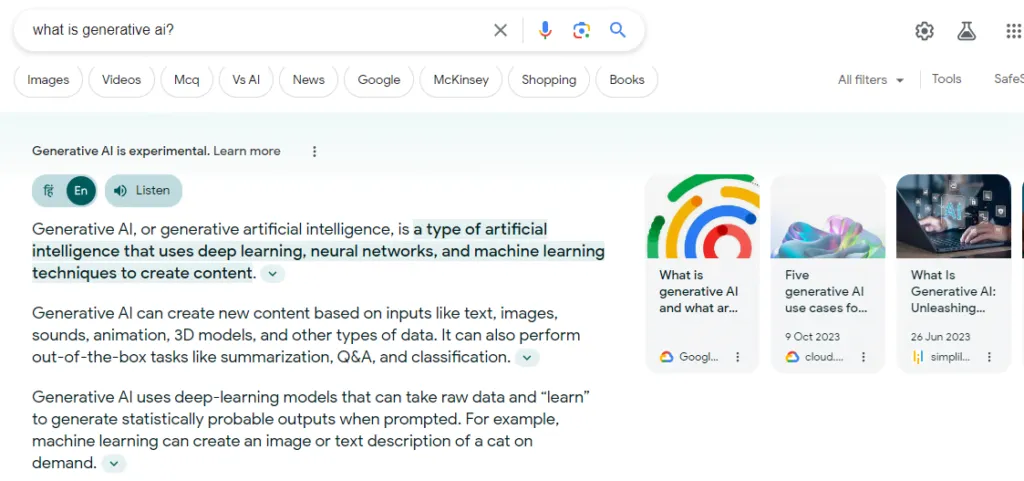
How a generative search engine works
Behind the answer sits a simple sequence:
- Understand the question. The system works out what you mean, including context and follow-up questions, beyond the individual words.
- Retrieve sources. It searches an index of the web, or the live web, for pages likely to contain the answer.
- Write the answer. A language model reads the retrieved passages and writes a summary in plain language.
- Cite. Most systems show the sources they used, so that you can check them or read more.
This retrieve-then-write pattern is the same idea businesses use to make AI answer from their own documents. We describe it in our guide to building a knowledge base with RAG.
What users gain
- Speed. One synthesised answer replaces the work of opening five tabs and comparing them.
- Better handling of complex questions. Long, multi-part questions that were awkward as keywords now work as written.
- Follow-up. You can refine the question in conversation instead of starting again.
- Different formats. Many systems accept images and voice as well as text.
What publishers and businesses risk
The change is less comfortable for anyone who depends on visits. In Pew Research Center’s study of the browsing of 900 US adults in March 2025, people clicked a traditional result link on 8% of visits when an AI summary appeared, compared with 15% when it did not. Links inside the summaries were clicked on just 1% of visits.
Two other concerns are worth knowing about. Answers can be wrong, and a confident summary can hide that. And users often can’t tell how the engine chose its sources, which raises questions of fairness and transparency.
What is still changing
- More modes of input. Searching with a photo, a screen or a voice question is becoming ordinary.
- Personalisation. Systems increasingly use your own context, such as location and past questions, to tailor answers.
- Action, not only answers. Assistants are beginning to compare products, book appointments and complete purchases on a user’s behalf, which makes accurate, structured product and service data more valuable.
- Better checking. Providers are working on showing sources more clearly and flagging uncertain answers.
What to do about it
You can’t control how search engines present answers, but you can make your pages the kind they draw on:
- answer buyer questions directly near the top of the page, in plain words
- keep facts accurate and dated, and cite your sources
- structure pages with clear headings and add structured data
- make sure AI and search crawlers can reach the pages you want quoted
- build your reputation beyond your own website, since these systems read the whole web
- track how your brand appears when you ask the questions your customers ask
Our step-by-step guide to SEO for AI search covers each of these, and our piece on using generative AI in your SEO workflow looks at the production side. If you’d like to see how you appear in AI answers today, that is part of our AI-era growth work, and you can talk to us about a review.
Questions
What is a generative search engine?
A search engine that uses a language model to read relevant pages and write a summarised answer to your question, usually with links to the sources. Examples include Google's AI Overviews and AI Mode, ChatGPT's search, Perplexity and Microsoft Copilot.
Is ChatGPT a search engine?
It started as a chat assistant that answered from its training. It can now search the web and cite sources, so it works as a search tool as well. Google, in contrast, began as a search engine and has added AI-written answers on top.
What are the main types of search engine?
Crawler-based engines that index the web, directories that list sites by category, hybrid engines that combine methods and metasearch engines that gather results from several others. Generative engines add a layer that writes an answer from the results.
What is the difference between SEO and AEO?
SEO aims to rank your pages in search results. Answer engine optimisation (AEO) aims to have your content used and cited in AI-written answers. They overlap heavily, since both reward clear, credible, well-organised pages.
Will generative search kill website traffic?
It reduces clicks on many informational searches. Pew Research found people clicked a result link on 8% of visits when a Google AI summary appeared, compared with 15% when none did. Traffic that remains tends to come from people who want more detail, so quality and brand matter more.