Growthplaybook
SEO for AI search: how to get your business cited by ChatGPT, Perplexity and Google
A practical guide to being found and quoted by AI search: crawler access, structure, evidence, authority beyond your site and a 30-day plan.

In this article
Here is what is happening to some of your traffic, whether or not it shows up in your reports. Someone searches for a problem your business solves. An AI assistant, whether ChatGPT, Perplexity or an AI summary at the top of Google, pulls together an answer and names a few sources. The person reads the summary and leaves. Your site was never visited, and your top ranking did nothing for you.
The effect is measurable. Pew Research Center tracked the browsing of 900 US adults in March 2025 and found that people clicked a traditional result link on 8% of visits when an AI summary appeared, compared with 15% when none did. Clicks on the sources cited within the summary were rarer still, at 1% of visits.
None of this means traditional SEO is finished. It means there is now a second place to be found: inside the answer. This guide sets out how.
What changes, and what doesn’t
Search engines still crawl pages, rank them and send visitors. AI search adds a layer that reads several pages, writes a response and cites some of them. The pages it chooses are those that are easy to reach, easy to understand and easy to trust.
That is why many of the foundations are the ones good SEO already needed: a fast, crawlable site, clear headings, accurate content and a sensible structure. We cover those in our guide to website structure for SEO. What AI search adds is a stronger premium on direct answers, cited evidence and your reputation across the web, not only on your own domain.
The platforms don’t all pick the same sources, so don’t assume that doing well in one means doing well in all.
Four pillars
We organise the work under four headings: Visibility, Authority, Structure and Evidence.
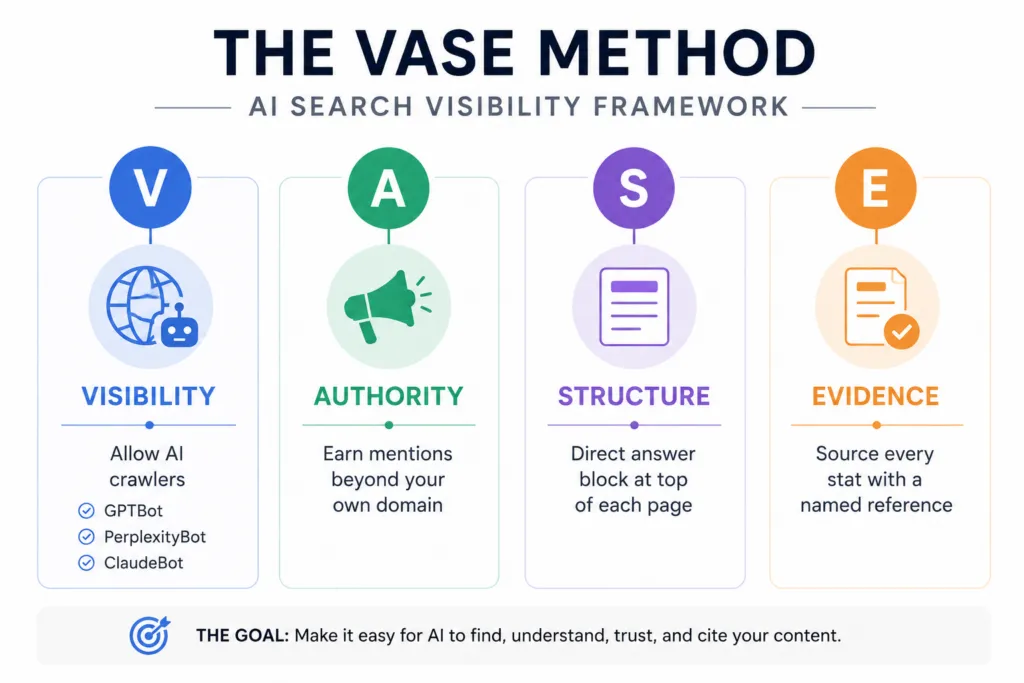
Visibility: can AI systems reach your pages?
If a crawler can’t read your page, it can’t cite it. Check four things:
- robots.txt. Look at what you allow and block. AI companies run different crawlers for different purposes. OpenAI, for instance, documents separate crawlers: OAI-SearchBot for search results, GPTBot for training its models, and ChatGPT-User for requests a person makes directly. Perplexity and Anthropic publish their own. Decide deliberately which you want to allow. If you want to be cited in answers, the search crawlers need access.
- Plain HTML for key content. Some crawlers don’t run JavaScript well, so keep headings and main text out of script-only components.
- A clean sitemap and no accidental blocks on your important pages.
- Speed. Slow pages are crawled less and abandoned more.
Authority: does the wider web treat you as a source?
AI systems learn about you from the whole web, not just your site. Brands that get cited tend to be mentioned in trade publications, industry directories, forums, podcasts and reference sites. You can’t buy this. You earn it by being useful where your buyers and peers already look: contributing data or commentary to publications in your field, answering questions on forums and communities honestly and helpfully, and keeping your profiles and listings accurate and consistent.
Structure: can an answer be lifted cleanly from your page?
This is the pillar where most companies have the most to gain. Give each section a heading phrased as the question a buyer would ask, then answer it in the first sentence or two, in plain words, before adding detail. Use short paragraphs, lists for steps, tables for comparisons and a section of real questions and answers. These habits help human readers as much as they help AI.
Add structured data so machines can read your content reliably: Article on editorial pages, FAQPage where you answer questions, Organization on your home page and BreadcrumbList for navigation. Structured data doesn’t guarantee a citation, but it removes ambiguity.
Evidence: do you back up what you say?
AI answers favour content that names its sources. Attribute every statistic to a named source and year, link to the original, and avoid vague claims like “studies show”. Original data, such as a survey of your customers or an analysis of your own results, is among the strongest signals, because nobody else has it.
Platform notes
- ChatGPT. Uses its own search crawler and the wider web. Clear answers, readable pages and mentions on other credible sites matter. Check that OAI-SearchBot isn’t blocked.
- Perplexity. Shows its sources for every answer, so it rewards accurate, well-sourced content and pages from credible domains.
- Google’s AI features. Draw on Google’s normal index, so classic SEO, structured data and signs of expertise (named authors, dates, clear ownership) remain the main levers.
- Others. Gemini, Copilot and Claude each retrieve information in their own way, which is why it pays to test the same questions in each.
The platforms update frequently, so treat any detailed claim about how one picks its sources as provisional and check by testing.
Measuring it
You can’t improve what you can’t see, and Search Console doesn’t show every AI mention. Use three methods.
- A monthly manual check. Ask ChatGPT, Perplexity, Gemini and Google your 10 to 20 most important buyer questions. Note whether your brand is named, whether your domain is cited and who is cited instead. It costs nothing and tells you more than any tool at the start.
- Search Console. Google reports on how your pages perform in its search features, which now includes its AI experiences. Check what is available in your account.
- A separate analytics channel. Group visits from AI assistants (for example chatgpt.com, perplexity.ai, gemini.google.com, copilot.microsoft.com and claude.ai) so you can see their volume, conversion and revenue next to ordinary search.
Several paid tools now track brand mentions across AI answers. They are useful at scale, but the manual check is enough for the first quarter.
A 30-day plan
Week 1: audit and access
- Run the manual check on your top 20 buyer questions and record who is cited.
- Review robots.txt and make a conscious decision on each AI crawler.
- Set up the analytics channel for AI referrals.
Week 2: structure your ten most important pages
- Add a short, direct answer under each main heading.
- Rewrite headings as the questions buyers ask.
- Add structured data for articles and questions.
Week 3: build authority
- Find the five forums, communities or publications where your buyers look and contribute something useful.
- Offer a data point or a comment to two or three trade publications.
- Check that your company and product pages on directories and reference sites are accurate.
Week 4: publish and measure
- Publish one comparison or buyer’s guide that answers a question your sales team hears often.
- Publish one piece built on your own data.
- Repeat the Week 1 check and compare. Set a monthly baseline.
Where to go from here
The same discipline helps your human customers too: clearer pages, honest evidence and a better-organised site. For a related walk-through, read how to get your company named when buyers ask ChatGPT, and our guide to using generative AI in your SEO workflow. If you’d like help with an audit of how you appear today, or a plan for your content team, that is part of our AI-era growth work, and you can talk to us about it.
Questions
What is the difference between SEO and AI search optimisation?
Traditional SEO aims to rank your page as a link in the results. AI search optimisation, often called generative engine optimisation (GEO) or answer engine optimisation (AEO), aims to get your content used and cited inside the AI-written answer. They share most foundations: crawlable pages, clear content, credible sources and good site structure.
Does ranking first on Google still matter?
Yes. It still brings the most traffic, and Google's AI features draw on pages Google already crawls and understands. But a high ranking alone no longer guarantees clicks, so pages need to be easy for AI to extract and cite as well.
How do we get cited in ChatGPT?
Make sure OpenAI's search crawler can reach your pages, answer the question directly near the top, support claims with named sources, and earn mentions on other credible sites, forums and directories in your field. Then check how your brand appears by asking the questions your buyers ask.
Do we need to optimise separately for each platform?
The foundations are shared, but the platforms do not use identical sources, so check each one. Run the same set of buyer questions through ChatGPT, Perplexity, Gemini and Google and note who is cited.
How do we measure AI search visibility?
Start with a monthly manual check of 10 to 20 buyer questions, Google Search Console's performance report, and a separate channel in your analytics for visits from AI assistants. Paid tracking tools help once you need to monitor at scale.
Should we block AI crawlers?
That is a business decision. Blocking search crawlers keeps you out of AI answers. Blocking training crawlers is a separate choice about whether your content may be used to train models. OpenAI, for example, publishes separate crawlers for search and for training, so you can treat them differently.